A man swings a stone tied to a string of length  in a vertical plane. The string remains stretched throughout the time of rotation.
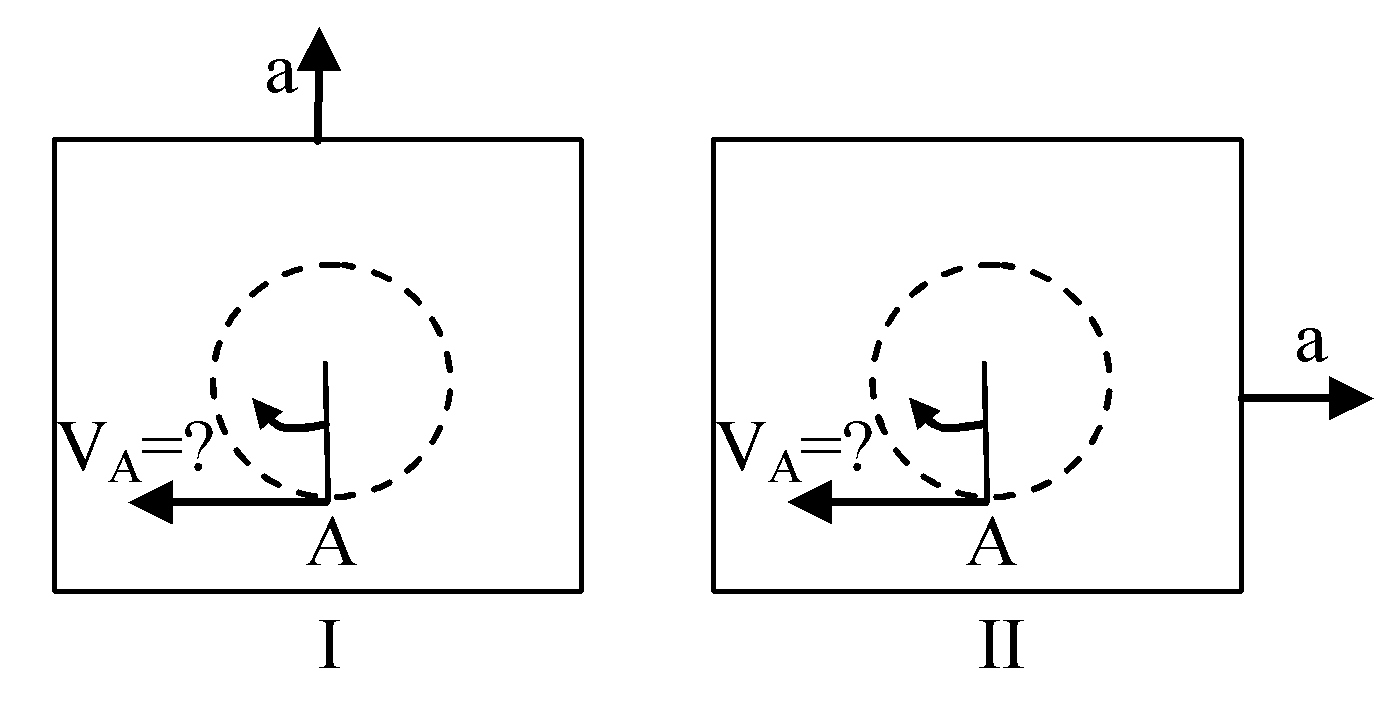
Let us consider the two following cases:
(1) The man is in a elevator going up with an
acceleration a . What is the minimal velocity v A of the stone, relative to the man, necessary at the lowest point of its path, to keep the string stretched throughout the time of rotation (see fig.I)?
(2) The man is traveling inside a cart that accelerates to the right with acceleration a .
Text Solution
Verified by ExpertsCHECK THE SOLUTION.
Sol. 1 There are two constant forces which act on the stone in the elevator gravity and the force of inertia (D’alembert’s force). The sum of the two constant forces can be called the “effective gravity” in the elevator system.
 =
=  +
+  = mg + ma = mg eff (down) ….(1)
Thus, g eff = g + a is directed downwards. We will use this effective gravity in our calculations from now on. The point at which the tension is minimal, is the point at which the tangential velocity is minimal. At this point, the kinetic energy will also gain a minimal value, giving rise to a maximal value of the potential energy. This point is the peak of the stone’s path. The forces acting on the stone at this point are depicted in fig. To express all the force in one equation, we write :

Mg eff + T =  ……….(2)
For minimal tension, T = 0 we obtain
V c =  ……….(3)
Using the law of conservation of energy, we arrive at :
 mv A 2 =
  mv c 2 + mg eff .2 λ ……….(4)
Plugging  into Eq. instead of v c , we
V A =  ……….(5)
As in the previous section, we first calculate the effective gravity (see figure.b)

 =
=  +
+  =
=  = mg eff
  = m
= m  ……….(6)
Where g eff is calculated using the Phthagorean theorem.
We repeat the calculations, this time using the new g eff . At the point B we have (see fig.c)
tan θ =  ……….(7)

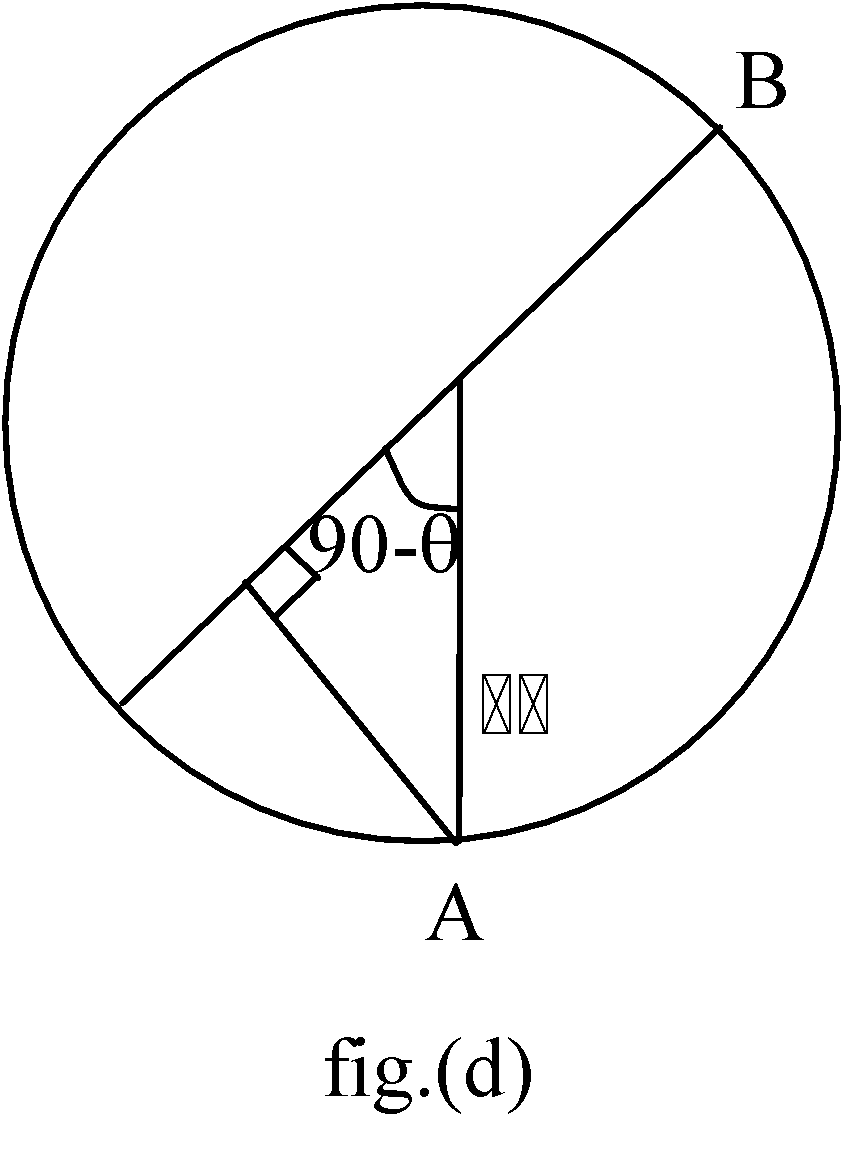
Note that the plane of reference of the potential energy is now rotated an angle 90º– θ relative to the “ordinary” horizontal plane. The reference plane is always vertical to  , and in our case,
  is not in the –
  direction.
The force equation is :
mg eff + T = m  ……….(8)
Substituting g eff and T = 0, we see that
v B =  ……….(9)
Using the law of conservation of energy, we write
 mv A 2 =
  mv B 2 + mg eff H ……….(10)
Note that now the point A is not on the plane of reference. H is its distance from the reference plane (see fig.d) H is clearly
H = λ + λ sin q = λ (1 + sin θ ) ……….(11)
Therefore,
v A 2 = v B 2 + 2  ……….(12)
Or, finally, v A =  .……….(13)
Prepare Smarter with CGP Edu
Get practice questions, solutions, and test series in one place.
Write a Review
Share your experience with this question and solution.
Commentary
Send your comment, doubt, correction, or feedback to admin.
Similar Questions
Explore conceptually related problems